Friday, November 15, 2013

The Drowned Man: An Exceedingly Spoiler-Free Review of a Cult Classic in the Making


Lasciate ogni speranza, voi ch'entrate

Before we exit the elevator to begin our descent into hell, our guide hands us each a white mask and sets out three instructions: 1) Do not remove the mask under any circumstances, 2) Do not speak, and 3) Do explore.

With that, I enter the world of The Drowned Man, Punchdrunk Theatre's "immersive" experience, and this decade's new cult classic.

Mature Audiences Only:
So reads the warning on the National Theatre's Website, and very rarely has the M-word carried so much weight.  The fairly traditional NT is serving as co-producer, and its warning is an important one to understand: this "play" requires an open mind, a loss of inhibition, and a very brave spirit.  If you're not prepared for (or even relish) unsettling experiences, this is not for you.  The most courageous should also, to maximise the experience, go into it with a very minimum of advance knowledge.

So, what can I say about this very loose adaptation of Buchner's Wozzeck, without spoiling the experience?

The Plot:
This is in some ways the easiest to share, as its core is completely laid out for the audience before the show even begins.  Echoing Wozzeck, we are informed that we are about to experience two concurrent story-lines: in each, a betrayed lover enacts brutal vengeance before meeting a very watery fate.

How it Works:
The truly spoiler-averse should stop reading here, but it's probably fair to reveal that this is not a normal theatrical experience.  Playing out more like a haunted house (or a video game (more on that in a bit)), what you're actually doing is exploring a completely open world laid out across four massive levels and a labyrinthine network of sets.  These range from the minuscule (hidden rooms abound) to the gigantic (full neighbourhoods, the interiors of large buildings, and so on), all of which offer glimpses into an even more labyrinthine set of narratives that's being acted out by a cast of 40-odd dancer-actors.  

Now, it's easy enough to just spend the night following one character after another as they make their way around the world, and that's one way to see a fair amount of the plot and sets.  However, you'd be remiss if you didn't also spend some time wholly on your own (surprisingly easy to do), summoning up the courage to head off the beaten path and seek out, almost Easter-like, the (dark, creepy) treats awaiting the courageous adventurer.  It really is like a video game world, where as the outsider you're free to wander through the lives, homes, and settings of the characters.  You're free to paw through characters' belongings, digging through drawers, opening letters (which often reveal interesting plot details), and getting up close and personal in a way theatre never permits.  At times, there is almost a feeling that you're the haunter, and the actors the haunted: Every time a character sets aside a personal article, and some faceless audience member picks it up for a quick inspection before the character comes back, it's definitely a strange moment.

The Set: 
Is as important as the plot, if not more so, and all I'm willing to reveal is that if you've ever wanted to explore Twin Peaks, this is the closest you'll get.

A Sense of Dissatisfaction: 
The show has taken some flack for being too obscure, its narrative too hard to piece together, an "Emperor's New" Play, so to speak.  To this I say: you're missing the point if you expect to get at the whole story.  Indeed, the pleasure of the experience is in only getting a glimpse of this strange new world, ever-so-briefly inhabiting a space where you know full well that there is so much more going on.  Yes, when it ended, I did feel a vague sense of disappointment that I'd seen so little of the world (whole rooms and characters, apparently), but is there any fault in theatre that makes you want to see it again? 

Some tips: 
DO go with a friend so you can compare notes afterwards.
DON'T stay with your friend the whole night.
DO push boundaries: there is very little against the rules, and there are very carefully placed staff in place to prevent you from doing anything too stupid.
DO follow some of the tertiary characters.  It becomes pretty obvious who the main narrative agents are (and tempting to only stick with them), but you risk missing out on an exceptional (and potentially intimate) moment with a security guard, secretary, seamstress, or any one of the other characters that populate the world.

Finally:
DO go see it.  Provided you have an open mind, it's an experience you'll never forget.

Wednesday, December 12, 2012

An Unfinished Journey (The Year in Review 2012)


One of the advantages of not being a professional journalist is that I can deliberately overlook buzz, making my first experience with a film or video game something entirely special - and surprising.  At least two of my picks this year fall in this category, so I tread very careful waters in un-spoilering any description of those works.  If you can, get your hands on 'em before someone spoils the experience!  Now, on with the show:

Film:
If ever there was a "the buzz is distracting" film, it's THE MASTER.  Paul Thomas Anderson's follow-up to THERE WILL BE BLOOD is, yes, based on the inner workings and early goings of L. Ron Hubbard's Scientology cult, and a fascinating exposé of what goes on on behind its tightly closed doors.  Nevertheless, the movie is ultimately less about the group than about the individual experience, in particular the brutal but compelling relationship between Philip Seymour Hoffman's eponymous villain and Joaquin Phoenix's loose cannon apprentice.  Like Daniel Day-Lewis before him, the give-it-all performance by Phoenix is a shoo-in for the Best Actor Oscar.


Sarah Polley's highly personal STORIES WE TELL is a documentary about a family secret.  Aaand... to say more would be a disservice.  Suffice it to say, there's something about the Polley family, and over the course of 90 or so minutes, our hero sets out to resolve it.  Of course, this being an indie/arthouse doc, her approach to the form is a bit unusual.  Try not to spoil it for yourself!


The Blockbuster counterpoint to last year's TREE OF LIFE, CLOUD ATLAS is an art film for the masses.  It's grand(iose).  It's philosophical.  It tries to say something about the meaning of life.  And it's one hell of a thrill ride.  Tying together stories of multiple characters across multiple generations (the element of reincarnation is key here), it paints a portrait of a world where everything we do is fated... and where the "chosen ones" have something greater to contribute to the Tree of Life (or the Matrix (or whatever you feel like calling it)).  Tom Hanks and Halle Berry are the big names filling multiple roles, but it's Jim Sturgess (as both a 19th century lawyer and 30th century freedom fighter) and Ben Whishaw (as an early twentieth century composer) who give the standout performances.  Hugo Weaving (Elrond, Agent Smith) is also a treat as the villain who just won't go away.

Video Games:

Easily the greatest work of art in gaming history, thatgamecompany's JOURNEY tells an elegant and sparse story of one avatar's narratively ambiguous adventure.  As the game begins, you find yourself dropped in the middle of a desert.  There are tombstones and strangely patterned ribbons leading off into the distance.  Further on, a mountain beckons.  As you proceed, a stranger appears.  He appears friendly (in fact, he's a real person, who's joined your world via the magic of the Internet) chirping happily alongside you in an incomprehensible language.  Soon, you've developed a buddy system, using Morse-like code to indicate hidden treasure (or enemies) and finding strength in numbers.  As you proceed through your journey, each area one visual marvel after another, you grow to love your new friend, and come to fear for his safety.  Your journey together isn't a long one, but what's there - the visuals, the music, the narrative turns - is the most beautiful yet created for this interactive medium.  Even without an internet connection (and I have since taken the journey alone), it's still a wonder to experience.

A close second for Masterpiece of the Year is THE UNFINISHED SWAN.  Developed by graduates of the same program that gave us thatgamecompany, it's another elegant and surprising little tale.  Like Journey, you're dropped in the deep end: an empty white space that starts filling with black splotches as you hammer buttons on your controller.  Eventually, you begin to get your bearings, and it becomes apparent that the world has been erased; it's up to you to restore it with your paintball attacks... and to chase those odd birdlike orange footprints out into the world.  It's a wonderful mechanic, and as the narrative progresses and shadow and colour are added to the mix, you find yourself in a real work of beauty.  The story is quite touching too, a fairy tale for the 21st century (guest starring Terry Gilliam!).


It may not have had the perfect conclusion, but damned if the MASS EFFECT TRILOGY isn't one of the all-time great space operas, comparable even to Star Wars or Trek.  (And Garrus Vakarian is at least as cool as Han Solo.)  As blockbuster interactive entertainment goes, there ain't much better than this Canadian-made series.  The epic finale sees Commander Shepard (customise your appearance, gender, and first name) facing off with the evil Collectors for one last galactic brouhahaha, Home Team Advantage.  As Earth fights to stave off the invaders, a rogue faction of humans (led by Martin Sheen in a great voice performance) is hatching its own nefarious plans, throwing you in the middle of a conflict fought on multiple fronts.  The choose-your-own story-telling is top notch - those who've been around since the first game will see the consequences of earlier decisions play out here - and features at least one heart-wrenching decision that you'll be contemplating for days and months to come.  Hell, I still feel bad about my choice... which is, of course, the point of this series.  It's always been best when it puts the big decisions in the hands of the player, and there's just nothing else like it out there.  Amazing.

Bonus Can-Con Award:

As usual, a special shout-out to a homegrown favourite, Toronto's Drinkbox Studios and their Game of the Year nomination for Tales From Space: Mutant Blobs Attack!

Tuesday, December 27, 2011

The Year in Review 2011


I don't think there were enough greats to merit a Top 10 list, but here, in a very particular order, are my Top 5 in: 

Film

Riveting and surprisingly frightening, TAKE SHELTER showcases Michael Shannon (best known for supporting roles in such films as REVOLUTIONARY ROAD) in a compelling performance as Curtis LaForche, a small-town family man whose haunting visions of impending disaster compel him to increasingly bizarre behaviour. And though he believes he may be going insane, the great tragedy at the heart of this story is that despite this awareness, he cannot help but obey his compulsions (among other things, installing a massive storm shelter in his backyard, at great expense). This is one of the great big-screen treats of 2011, and is bound to lose something in the translation to TV (or, God forbid, laptop monitor). 

 Do not let the religious theme of Xavier Beauvois's OF GODS AND MEN turn you away. An examination of the cruelty and meaninglessness of war, it tells the true story of a small group's devotion to protecting their community. Lambert Wilson is the lead, a French Trappist monk in a monastery in rural Algeria. As the country deteriorates into civil war, armed thugs (on both sides of the conflict) begin encroaching on the monks' sacred territory, and threatening the local Algerian community. Although the European monks are offered a peaceful exit, they must wrestle with their responsibility to not abandon the Algerian Muslims who have been their neighbours for so long. Insightful, profound, and intelligent, this is certainly the best foreign-language film of the year (though, sadly, it was not Oscar nominated in its original release year of 2010.) 

The latest adaptation of John Le Carré's TINKER, TAILOR, SOLDIER, SPY is a complex, intellectual, Cold War tale: Gary Oldman (like Shannon, acclaimed for too long as merely a supporting actor) stars as George Smiley, ex-British Secret Service called back to duty to uncover the identity of a high-ranking Russian mole at the heart of the British intelligence establishment. The globe-spanning investigation delves into a botched Hungarian defection, a love affair between the wife of a Russian diplomat and agent Ricki Tarr (Tom Hardy, excellent), and into Smiley's own broken personal life. Although the story is simultaneously slow-going and yet incredibly difficult to follow, the payoff is worth it, and the dénouement(s) sublime. 

Surely the most divisive film of 2011, Terrence Malick's THE TREE OF LIFE is a meditation on life, death, beginnings, The End, and a whole lot more. At its best, it takes audience on an audio-visual roller coaster through the history of time, and through the emotional roller coaster of a broken family in the American 1950's (with Brad Pitt at its head). At its worst, the meandering non-story, bizarre camera work, and voice over heavy dialogue are sure to turn some viewers completely off. Nevertheless, I thoroughly enjoyed the ride (much more so than in Lars Von Triers's similar MELANCHOLIA), and I suggest the inquisitive viewer check this one out. 

Although it has the most unnecessary use of 3D in a film this year, Wim Wenders's PINA is still an enthralling performance documentary. The conceit - intersperse late dance choreographer Pina Bausch's greatest pieces with commentary from dancers in her company - actually doesn't work that well: while the dance performances testify to Pina's brilliance, the interviewees are needless time-fillers, coming off as pretentious and fawning with nothing interesting to say. Still, as a performance film, it is nothing short of breathtaking, and the dances (which we get in tantalizing excerpts, some admittedly too short) cover a wide range of moods and styles. Highlights include: The lovers in a madhouse being controlled like puppets, Bausch's take on the Stravinsky Rite of Spring, the comical Robot-like one-man piece, and the disturbingly sexual poking and prodding of an elder female dancer by a large group of black-suited men. Not to be missed for anyone interested in the vanguard of contemporary art. 

 And on a lighter note, 

Video Games!:


The sequel to arguably the greatest video game of this generation, PORTAL 2 improves on the original with its better, funnier, and more subversive story. Also, with its wonderful characters, magnificently crafted universe, and, yes, the brain-tingling gameplay. For those unfamiliar with the series, it is based on a single gameplay mechanic: the eponymous gun that allows its user to "warp" from one destination to another by creating entry and exit portals at whim. Of course, it's not just a question of shooting one's way to an exit, but rather of solving increasingly complex - but never impa(o)ssible puzzles - while dealing with an hilariously idiotic robot sidekick (voiced by "The Office" and "Extras"'s Stephen Merchant) and his villainous counterpart, the infamous GLaDOS. 

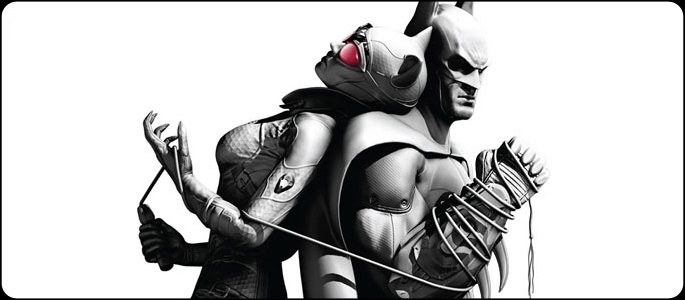
Although I am some distance from finishing the game's main storyline (let alone its hundreds of side quests), I believe I can safely rate BATMAN: ARKHAM CITY not just the greatest comic book video game ever created, but one of the best stealth games, ever. Taking everything cool about Batman (the gadgets, the Ninja-like stealth, and the Bathook/Batcape glide mechanic), adding in a healthy dose of comicdom's bizarrest villains (with Mark Hamill-voiced Joker at the very top), and one of the most satisfying combat systems around, B:AC is undoubtedly one of the coolest games this year. From the smoke bomb/grappling hook escapes, to the building ledge takedowns (reach up and pull a thug off a ledge and leave him on a rope, dangling), through the glide sessions across Gotham Arkham City, this game has probably the best stealth mechanics since Metal Gear's Cardboard Box. 

While not as innovative as its predecessor Rez, CHILD OF EDEN is certainly the trippiest game of the year, taking players on a brief but memorable acid trip through the "internet" of tomorrow: a mindscape of strange organisms to "purify" with a weapon that activates in time to the soundtrack of the game. It's as bizarre as it sounds, but if you can handle the aesthetics, it's one of the most beautiful and original games of this generation.  


Honourable Mentions: 

The Pride of Toronto, SUPERBROTHERS: SWORD AND SWORCERY EP briefly burned up the iOS charts as the year's great point-and-click adventure game. Of course, it wouldn't be on this list just for bringing back a genre I love: like other favourites, its subversion of the genre is what won me over: in particular, its constant breaking of the fourth wall, use of the iPod/Phone/Pad's abilities, and fantastic soundtrack (also, coincidentally, tied to the action on screen). The game definitely requires patience - certain parts literally require the player to set the game down and walk away - but it's worth the effort. 

And the best game I technically haven't played yet: ULTIMATE MARVEL VS. CAPCOM 3, for finally allowing me to create a team consisting of Nova (from Marvel Comics' New Warriors), King Arthur (from Ghosts 'n Goblins), and Amaterasu (from Okami).

Tuesday, July 26, 2011

The greatest video game of our time is Canadian.


I realise this is ostensibly an arts blog, so right off the bat I will say that I endorse the idea of video games as art. Moving on...

Recently, IGN published its picks for the Top 100 Modern Games. The category was specifically designed to recognise that, despite the lasting popularity of classic titles like Ocarina of Time and Super Mario, most modern gamers are either too young to be interested in those old titles, or old enough to have already played through them. That left IGN with the worthwhile task of picking the best of the current generation. (Interestingly enough, IGN saw fit to include a number of free-to-play and iOS games, including Angry Birds).

IGN's choice for best game overall is Mass Effect 2, developed by Edmonton-based BioWare for the Xbox 360 (and later ported, with some major problems, to PS3*). IGN is not alone, either: aggregate review site Metacritic places Mass Effect 2 twelfth, but only two points behind #1 Grand Theft Auto IV. Gamesradar ranks it the #10 greatest of all-time, superseded only by Half-Life 2, Shadow of the Colossus (my personal #1), a Mario game, a Zelda, a Metroid, GTAIV, Chrono Trigger, Tetris, and Portal.

The greatest game

Mass Effect 2 is the middle entry in a galaxy-spanning trilogy of sci-fi titles, which concludes next year with the release of Mass Effect 3. The game features Commander Shepard - male or female, depending on your own character creation - and his/her quest to stop the evil Reapers from destroying the universe. Like Star Wars: Knights of the Old Republic, BioWare's last great success, it is an action RPG, in which story, character, and player choices are more important than gameplay. In addition to deciding gender and appearance, your character has a customizable personal history, and his/her decisions have major repercussions not only within the current game, but also its sequel(s).


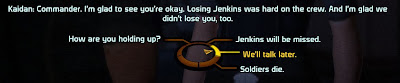
The Mass Effect Dialogue Wheel. "Paragon" options are at the top. "Renegade" at the bottom. You can be a real jerk in this game if you want to.

This last point is what makes the Mass Effect series so special: a decision to, say, spare the life of an enemy in Mass Effect 1, might have that character reappear in Mass Effect 2 either as a new ally, or engaged in even worse behaviour. There are also a few major plot branches in each installment, leading to some heart-wrenchingly difficult decisions for the player. These can range from deciding which teammates to leave behind, pursuing a romance, or split-second decisions on the fate of the galaxy itself. There's no video game experience quite like it: playing through Mass Effect 2 and seeing repercussions from Mass Effect 1 is something truly special. Who knew you could regret a choice made in a virtual world?

Canuck Pride

Anyway, all of this is to say that, as Canadians, we should do more to recognise BioWare. Unlike film and television, where Canada plays a lesser fiddle (way lower than second) to American programming, BioWare has (almost) single-handedly made Canada the king of the video game medium. (Here's to Canadian music, though! Bet you didn't know the #1 selling album of the 1990s was Shania Twain!)

On that note, I'm not sure what exactly Casey Hudson, Ray Muzyka, and the rest at BioWare have earned. At the very least, they should be due for the Order of Canada. For now, let's get them into the public eye!

Notes

There are lots of other great game companies in this country, too, so kudos to Next Level (Punch Out!), the Canadian divisions of Ubisoft (Assassin's Creed and Prince of Persia), Capcom (Dead Rising 2), Rockstar (Bully, as well as Grand Theft Auto IV's PC conversion), EA (Need for Speed, NBA Jam), and the many others out there.

*The big issue with the PS3 port of Mass Effect 2 is that there is no PS3 Mass Effect 1. This means that all those major decisions from the earlier game are missing, and the experience is less personalised. BioWare did release an interactive digital comic that allows players to make some major choices, but the smaller ones are overlooked, and the nuance missing from the 15-minute comic book experience.